
Why the Mind Remains Bound to the World
The soul seeks eternal fulfillment, yet the materially conditioned mind remains absorbed in Maya. This creates the inner conflict of material bondage.

The soul seeks eternal fulfillment, yet the materially conditioned mind remains absorbed in Maya. This creates the inner conflict of material bondage.

The soul is eternal, conscious, subtle, and Divine in nature. As an eternal part of God, it can never be fully satisfied by material happiness.

The body changes, the senses become active and inactive, and the mind fluctuates constantly. Yet the conscious self remains. Then who are we really?

If the self were material, material happiness should completely satisfy it. Yet dissatisfaction continues. This inquiry becomes the beginning of understanding the true nature of the soul.

The material mind and the material world are both formed from Maya. This creates natural worldly attraction and becomes the root of spiritual misidentification.

Why does the mind continue clinging to the world? Explore how worldly attachment blocks surrender and why detachment becomes essential on the spiritual path.
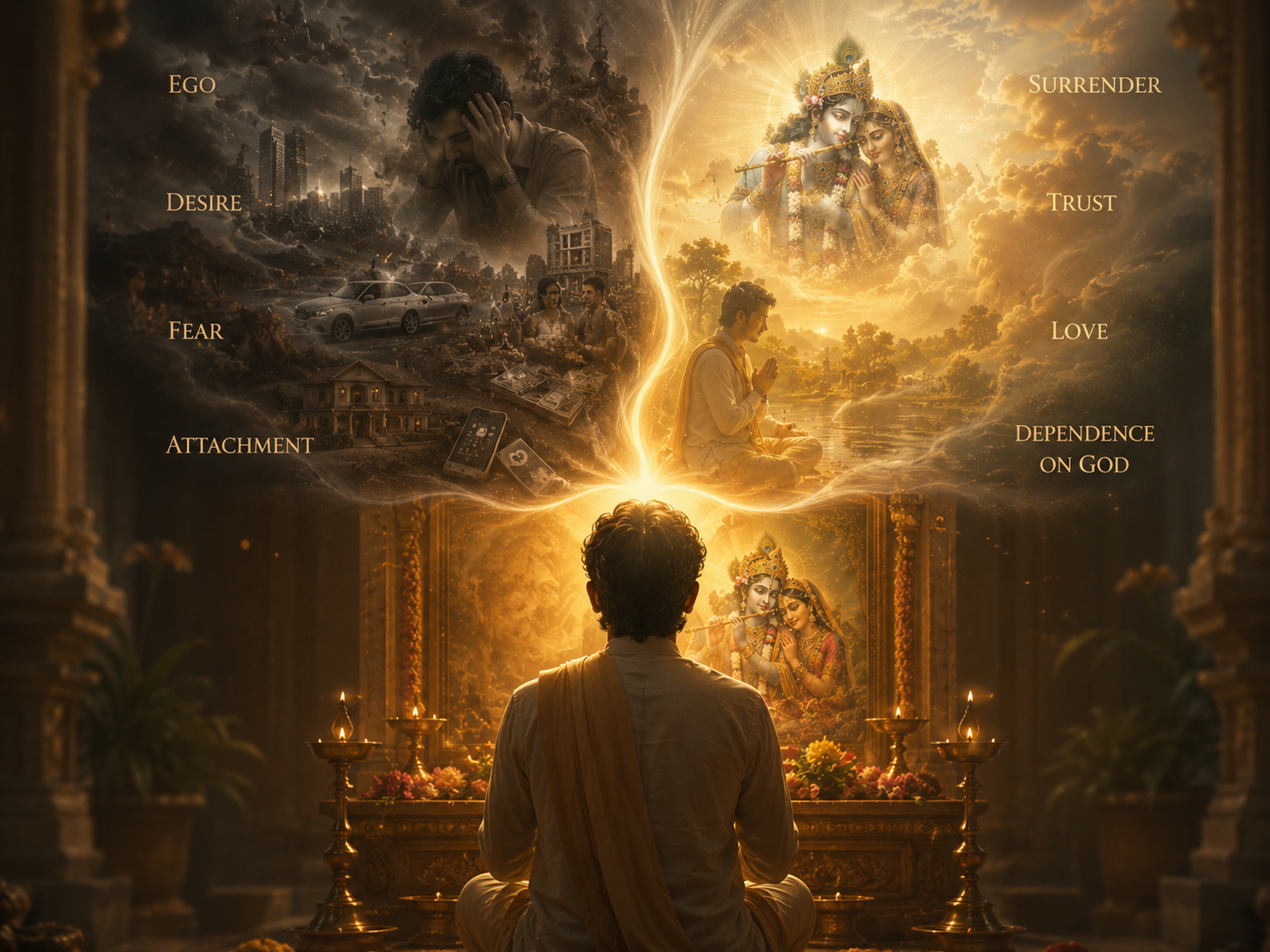
Learn why true surrender is not merely external action, but the gradual surrender of attachment, ego, and false dependence within the mind.

Discover the spiritual transformation that begins when the soul genuinely surrenders and comes under Divine Grace and protection.

Can surrender “earn” Divine Grace? Explore why surrender is not a transaction, why material effort cannot purchase Divine realization, and how Grace remains causeless.

What does surrender really mean? Learn why surrender is necessary before Divine Grace descends and how true dependence upon God transforms spiritual life.

If Divine Grace is necessary for realization, what must the soul do? The scriptures explain that Grace is not arbitrary. Spiritual effort prepares the heart, but surrender makes the soul receptive to Divine Grace.

Does God perform every action? The scriptures reject this misunderstanding completely. Discover why fatalism destroys spiritual life, and how Divine Grace and personal responsibility operate together.

aham chetana (अहं चेतना | ahaṁ cetanā) means the false ego. It is also called dehabhiman (देहाभिमान | dehābhimāna ) means false pride generated since the jeev considers itself to be a material body. The cause of this disillusion is Svarupavarika Maya aspect of Maya. This is a

Anu (अणु | aṇu) means small. Small is a relative size. But when this work is used to describe jeev (soul) then the it means so small that nothing can be smaller than it. Anu mean atom as well. LEARN MORE * Soul * Reference: * Who am I? Who is Mine? Vol. 1,

asura (असुर | asura ) are demons. Tamas guna of Maya dominates them. They naturally have sorcerer powers (मायावी) and are natural enemies of devatas . Their primary residence is Rasatal lok in the nether worlds. They are also called rakshasa (राक्षस | rākṣasa ). Hiranyakashipu, King Bali, Ravana, Mayasur,

aja kripaniya nyay (अजा कृपाणीयन्याय | ajā kr̥pāṇiyanyāya ) is another rule in the book of rules called Nyay Shastra. Word by word these are the synonyms aja = goat | kripaniya = sword | nyay = rule It simply means being in the wrong place at the wrong time. In

(आर्य | ārya) means the noble one. This is a term used to refer to respectable person in the Vedic civilization. Such a person followed the precepts of the Vedas and aimed to grow spiritually. LEARN MORE * Alternate spelling: aarya * Related Concepts: * Sanatana Dharma * Vedas * Devotion * REFERENCE * Prema Rasa Siddhanta

There are eight expressions of divine love called satvika bhava . Together they are referred to as ashta sattvika bhava (Devanagari: अष्ट सात्विक भाव ISO15919: aṣṭa sātvika bhāva ) These eight expressions of divine love are : * stambha - becoming stunned, * sveda - perspiration, * romancha - horripilation or

Anarth Nivritti refers to the dissipation of unwanted tendencies and impurities that obstruct devotion. * anartha — that which is not meaningful or beneficial for the soul * nivṛtti — removal or cessation It is the stage in Bhakti where inner obstacles begin to weaken and fall away. What It Is Anarth Nivritti is

anumana pramana (Devanagari: अनुमान प्रमाण ISO15919: anumāna pramāṇa ) is inferential evidence based on previous experience. LEARN MORE * pratyaksh pramana * shabda pramana Reference: Jagadguruttam - The Supreme Spiritual Master - A Biography

aana (Devanagari: आना; ISO 15919: ānā) was a former monetary unit and fractional coin used in India. The anna was a fractional coin of the rupee, with 16 annas making up one rupee. Although the currency is no longer officially used, the term remains prevalent in various expressions and references.

ashramavasi (आश्रमवासी; āśramavāsī) is a term meaning one who is resident of an ashrama (spiritual hermitage or monastery). An Ashramavasi is typically a dedicated spiritual practitioner who has made a conscious choice to reside in Guru's ashram and follow the teachings and spiritual discipline (sadhana) prescribed