Pillars of Sadhana Bhakti
Master the 7 pillars of Sādhana Bhakti: From Rūpadhyāna to Niṣkāmatā, learn the secrets of constant, exclusive, and selfless devotion to reach God-realization.

When you do bhakti of God and Guru, your sadhana bhakti stands mainly on four primary pillars. These pillars provide the practical techniques and internal shifts in perspective needed to progress on this path..
In addition there are three supporting pillars as well. This article will discuss all of those
The Four Primary Pillars
Roopdhyan
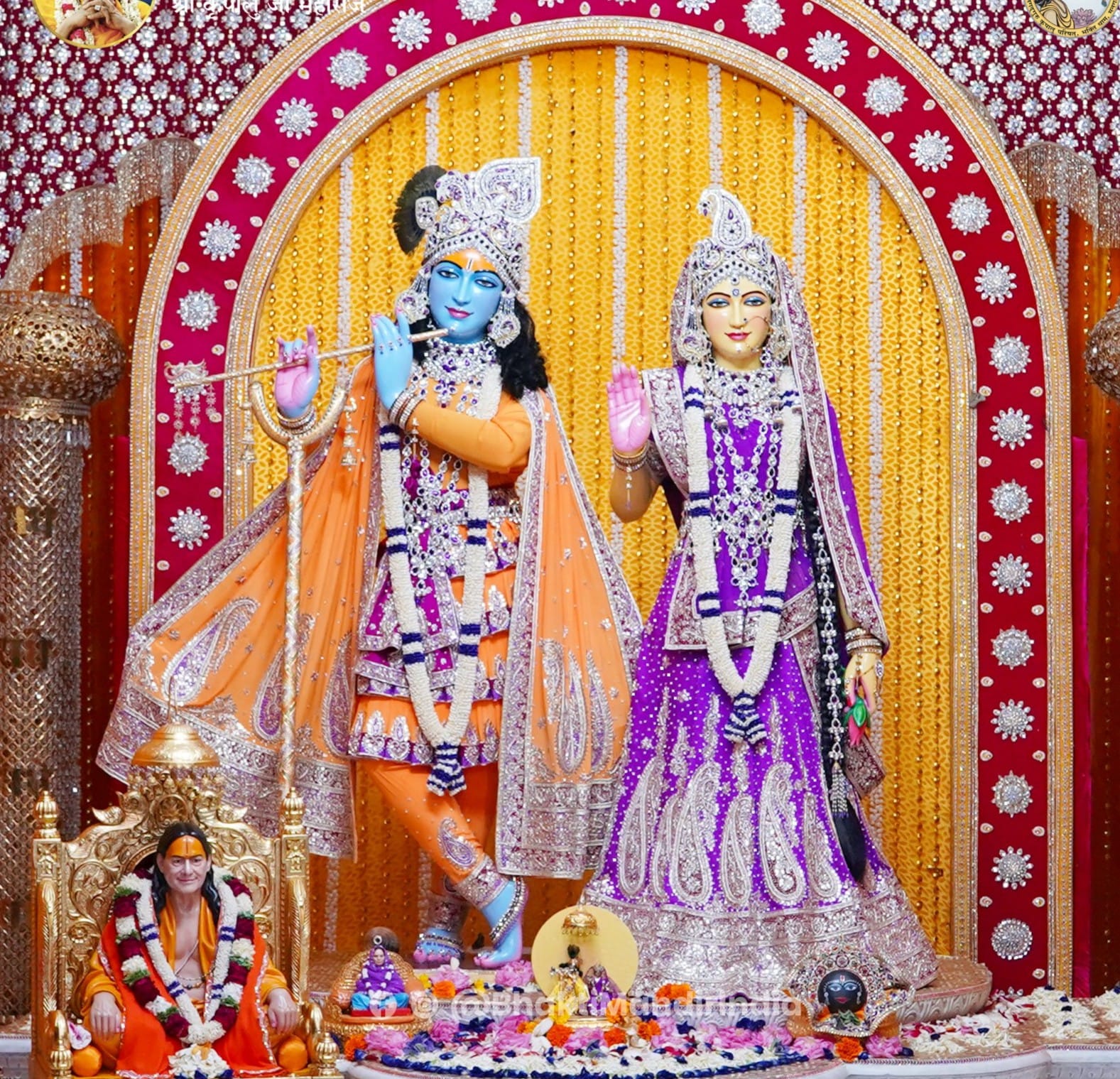
- Roopadhyana (रूपध्यान, rūpadhyāna) simply means meditating on a form of God. You might feel stuck, thinking, "I have never seen God, so how can I create His form in my mind?"
The truth is, you have performed Bhakti in many past lives. These past impressions are why you naturally find certain forms of the Divine more attractive than others. Whether it comes from your imagination, a sacred statue (Mūrti), or a painting of your Ishtadeva , choose the form that appeals to you most. Use it to build a living mental image of God, and then endow that form with the qualities you find most beautiful—such as being the "Friend of the Destitute," the "Redeemer of Sins," or the "Refuge of the Shelterless."
Once the form is set, develop feelings of deep love for Him. Engage in activities together: watch Him, serve Him, and even imagine enabling Him to have fun. This must be a mindful practice of devotional meditation. If the mind wanders, do not fret; simply bring it back. Because the mind naturally craves change, keep it engaged by changing your moods, His attire, or the activities you do together.
Your moods can alternate between being with Him and yearning to be with Him (Viraha). Yearning is the fastest way to dissolve material attachments, but if constant longing feels heavy, switch it up. Eagerly await His arrival, enjoy His presence, and then, as He departs, return to that sweet yearning. Furthermore, you can embrace different sentiments of love—treating Him as your Master, Friend, Child, or Beloved. He has given you this right; do not be bashful or scared, for He never finds such intimate love offensive.
Ultimately, Roopadhyana is the "anchor" that makes the next pillar of Sadhana Bhakti—Nairantarya (constant remembrance)—possible. Without a specific form to love and interact with, the mind finds it hard to stay attached. With an attractive form and creative variety, your mind will eventually stay with God for longer periods until it is so attracted that it simply stops going anywhere else. If the mind doesn't stay on the form, cry out to Him to make Himself more attractive to you.
Continuous Remembrance
- This concept of Continuous Remembrance, or Nairantarya (नैरंतर्य, nairaṁtarya), is the absolute requirement for spiritual success. In devotion, there must not be even a fraction of a second of forgetfulness of God and Guru.
The scriptures use the beautiful example of Tailadhāravatavichchinn (तैलाधारवतविच्छिन्न, tailādhāravatavicchinna)—the steady, unbroken stream of oil. When oil is poured, it forms a consistent thread that does not split or splash like water. This is exactly how a soul’s (jiva) thoughts must flow toward God: steady, unwavering, and uninterrupted.
The reasoning is simple yet profound: the mind is never truly idle. It has only two possible directions to go—the Divine or the Material. There is no middle ground. The moment the mind stops thinking of the Divine, it instantly falls back into material matters and worldly attachments. This state of unbreakable, unhindered devotion is described in the Shrimad Bhagavatam as apartihata (अप्रतिहता, apratihatā).
Total Selflessness
- Selflessness, or Niṣkāmatā (निष्कामता, niṣkāmatā), is the most essential part of devotion. It is the foundation that keeps love steady. To be selfless means there is not even a trace of desire for personal happiness; every action is performed exclusively to please Shri Radha Krishna and Guru. Without this pillar, love will fluctuate—increasing, decreasing, and potentially fading away.
As Shri Maharaj Ji states in the Radha Govind Geet:
भक्ति में निष्काम गोविंद राधे । भाव का होना मुख्य है बता दे ॥ bhakti mēṁ niṣkāma gōviṁda rādhē । bhāva kā hōnā mukhya hai batā dē ॥ (4154)
"The attitude of selflessness is paramount in Bhakti."
One must not harbor a desire for anything. This includes all pleasures on Earth, the heavenly planets (Svarga), and even liberation (Mukti) from Maya. The devotee doesn't hate Mukti, they simply find it "tasteless" compared to the nectar of Prema. It’s like offering a piece of dry bread to someone who is eating a royal feast. They don't reject the bread out of anger, but out of a higher preference.
Shri Maharaj Ji asserts that to attain the highest bliss of Divine Love, one must not even desire the bliss of Vaikuntha—which includes residing in the presence of Lord Mahavishnu, beholding His form, having a divine form like His, or sharing His opulence.
Furthermore, we must not even desire to please our own senses through the divine bliss of Shri Radha Krishna. This is the biggest confusion and the most significant hurdle for seekers.
To be clear, we do not have to become "feelingless" robots. Instead, this means we should desire to experience God and Guru with all five senses, but only with the intention of pleasing Them. This is a very subtle difference between experiencing God for your pleasure versus experiencing Him for His pleasure; yet, this distinction is what separates ordinary piety from the highest state of selflessness.
There is an unchanging divine law: God and Guru love you exactly as much as you love Them. Yet, They may sometimes act in ways that seem contrary to that love to test you. He "tests" the devotee not to make them suffer, but to help them scrub away the last traces of ego. It is a "tough love" designed for the jiva's ultimate benefit.
If your bhakti is not selfless, your love will diminish during these times, and you might turn away. However, if you maintain the sentiment, "He loves me so much, yet He is acting this way to test me; even these actions are adorable," then your love will never decrease. Instead, you will remain agnostic of His actions, and your love will always increase.
If selflessness is laced with even an iota of self-happiness, the highest Divine Love cannot be attained. The Gopis, who were totally selfless, attained the ecstasy of Maharasa. This highest state is unattainable even by Queen Rukmini, as her love contains a trace of self-happiness.
The Gopis offer the gift of their selfless love, and in return, Shri Radha Krishna make that love infinitely luscious. The devotee then enjoys that nectar purely as a gift from their Beloved. This is the state described in the Shrimad Bhagavatam as Ahaituki (अहैतुकी, ahaitukī)—causeless, selfless devotion.
Exclusiveness
- The fourth essential pillar of devotion is Exclusiveness, or Ananyata (अनन्यता, ananyatā). In the spiritual realm, focus is power. If your reliance is divided, your progress will inevitably stall.
As Shri Maharaj Ji emphasizes in the Radha Govind Geet:
भक्ति में कृष्ण प्रति गोविंद राधे । अनन्य अनिवार्य बता भाव बता दे ॥ bhakti mēṁ kr̥ṣṇa prati gōviṁda rādhē । ananya anivārya batā bhāva batā dē ॥ (4153)
"In devotion to Krishna, exclusiveness is absolutely mandatory."
Ananyata means surrendering all other supports. Whether you rely on your own physical strength, the protection of friends and family, your material wealth, or the worship of various celestial deities (Devi-Devatas), you break the exclusivity of your devotion. Even worshiping a multitude of different forms of God can scatter the mind's focus. Physically, you perform your duties to society, but internally, your "Prop" (support) and "Goal" are only Guru and God. Ananyata is not a call to run away to the forest; it is a mental state of singular dependence.
This exclusiveness applies to your chosen Deity, your path, and your guide (Guru). Jumping between Karma, Gyan, and Yog, or listening to a variety of different religious preachers, is detrimental to your progress. Those who are not Mahapurushas (God-realized saints) have not reached the goal themselves; their advice is a risk you cannot afford. Even among genuine Mahapurushas, styles and vocabularies differ. As humans, we lack the divine intellect to reconcile these differences. Listening to many sources only breeds confusion—and if your time is spent clarifying confusion, when will you practice Bhakti?
Following guidance of one saint is analogous to following the prescription of one trusted doctor to cure a specific illness. Mixing medicines from five different doctors—even if they are all great doctors—can be fatal. To avoid the "intellectual indigestion" of conflicting styles, carefully study the characteristics of a true saint. Pray to God for providing you a guide, stay in that saint's association, and introspect your own growth before making the informed decision to commit.
Human life is short, and its end is unpredictable. To reap results, you must maintain exclusivity to one form of God, one Guru, and one path. By selecting one specific image for Roopadhyana, that form becomes firmly rooted in your mind. Only then can you achieve constant remembrance without a gap of even a single second.
When your sadhana bhakti is supported by all these pillars then you will see meaningful progress day after day. The sign of progress in Bhakti is not seeing "lights" or having "visions," but a decrease in worldly anger, greed, and ego, and an increase in the desire to please God.
Supporting Pillars
Besides the above main pillars of the castle of bhakti there are few more supporting pillars, which are essential to build up to walk on this path.
Humility
Humility, or Dinata (दीनता, dīnatā), is the practice of being perpetually mindful of one’s own shortcomings and accepting them without pretense. It is the quality that makes the heart receptive to Divine Grace.
Chaitanya Mahaprabhu demonstrated the profound extent of humility required for true devotion. He famously taught:
तृणादपि सुनीचेन तरोरपि सहिष्णुना । अमानिना मानदेन कीर्तनीयः सदा हरिः॥ tr̥ṇādapi sunīcēna tarōrapi sahiṣṇunā । amāninā mānadēna kīrtanīyaḥ sadā hariḥ॥
"One should be humbler than a blade of grass, more forbearing than a tree, and respectful to others without expecting any respect in return."
Mahaprabhu identifies humility as the very first step on the path. One cannot truly set foot on the path of Bhakti unless they are humble, patient, and honoring of all beings. Dinata is not a sign of weakness; rather, it is a profound realization of the soul’s smallness in the presence of the Infinite.
You can cultivate this humility by consistently reflecting on your own flaws, maintaining a favorable and loving view of your Divine Beloved, and feeling His presence at every moment. When you realize that every breath and every ability is a gift from Him, the ego naturally dissolves, leaving behind the pure, selfless heart of a devotee.
Dinata is what makes Nishkamata (selflessness) possible. An arrogant mind always wants something for itself, but a humble mind is content in just being a servant.
Pathos
Feeling a deep sense of piety and longing due to separation from Shri Krishna is known as karuna (करुणा, karuṇā). To progress on the path of love, a devotee must develop a sense of insipidity—a feeling that life is "flavorless" without the Divine.
This state of pitifulness naturally results in shedding tears. Sometimes, a stream of tears flows as one contemplates His attributes of kindness, mercy, and love. Other times, a devotee sheds tears in remembrance of His divine pastimes (lilas), His incomparable beauty, or even out of a humble realization of one's own shortcomings.
It is crucial to understand the nature of these tears. Tears shed in the memory of God and Saints cleanse the heart and dissolve the ego. In contrast, tears shed for any material cause further contaminate the heart with worldly attachment. Since the primary purpose of Sadhana Bhakti is the purification of the heart, these divine tears are a powerful tool for progress.
In the material world, shedding tears is the first symptom of love; we cry both in the pain of separation and in the joy of meeting a loved one. The same principle applies to the Divine. In the beginning, we may need to make a conscious effort to cultivate this sentiment and shed tears for Shri Krishna. However, once the seed of love has sprouted, tears will flow incessantly and effortlessly, marking the transformation of the heart.
Tears of Love
The constant practice of remembering God naturally blossoms into a deep feeling of humility (Dinata), which in turn melts the heart and produces tears of love. These are not merely emotional reactions; they are recognized spiritual milestones.
As stated in the Ujjvala Nilamaṇi:
प्रेम्णः तु प्रथमावस्था अश्रुपुलकादयः । prēmṇaḥ tu prathamāvasthā aśrupulakādayaḥ ॥ "The initial symptoms of love are tears (ashru) and goosebumps (Pulaka)."
In the science of devotion, these tears are further distinguished by the mood from which they arise. There are two primary types:
- Tears of Union: When the soul feels the joy of meeting or proximity to Shri Krishna, the tears are cool to the touch.
- Tears of Separation: When the soul feels the intense fire of longing (Viraha) or the pain of being apart from Him, the tears are warm.
Beyond these, there are many subtle levels of tears that correspond to the depth of an individual's love. As the devotee’s attachment moves from the initial stages of shraddha (faith) toward the heights of Prema (divine love), the intensity and frequency of these symptoms increase. These physical signs serve as a confirmation that the "dry" practice of the mind is progressing towards the "moist" sanctuary of the heart.
Further Reading and References
- Related Concepts:
- References: